
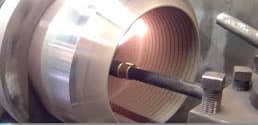
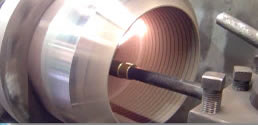
In a nutshell spiral welding is the process by which a cylindrical object has a new surface welded onto it whilst the object is being turned on a rotary turn table.
However, to understand this fully we first need to look at what exactly welding is, what are some uses of this specific process of spiral welding, and what are the advantages of spiral welding?
What Is Welding?
 Welding is the process by which two materials, usually metals or thermoplastics, are permanently bonded with each other. This result is created by heat being applied to both materials so that the areas of them which are to be joined melts, mixes, and then solidifies to form a permanent bond. In many cases of welding a filler material is also introduced to the join which then also melts and mixes with those of the materials being welded together. In these cases this mixture of materials when solidified forms a joint that is often stronger than the original base material.
However, the process of spiral welding introduces another material to the original (the substrate) in order to create a strong tough and durable overlay, rather than attempting to join it to a third material. The Spiral Welding process is applied in an inert argon gas atmosphere to prevent oxidation during the welding.
Uses of Spiral Welding
As mentioned above, spiral welding is the process of coating a cylindrical object with another material to renovate or recondition it. It can be used to rebuild damage from wear, erosion, corrosion or cracking, or to increase the dimension of the object to match it up to another part or matching component. It can be used on a wide variety of objects but is most commonly used on pipework and manufacturing shafts.
Advantages of Spiral Welding
There are many advantages to using spiral welding rather than other welding techniques. These can include:
- Repairing a component via the spiral welding process is often cheaper than buying a new component and results in less possible downtime.
- Faster turnaround time than manufacturing an entirely new component.
- Can result in a higher strength component than the original, depending on the choice of coating material.
- Spiral welding eliminates possible distortion of the substrate due to unbalanced stresses from normal welding processes.
To find out more about the spiral welding process and how it could benefit your business, contact the experts at IRS Ltd today.
If you’re interested in learning more about welding please read our article Different Types of Welding Explained.